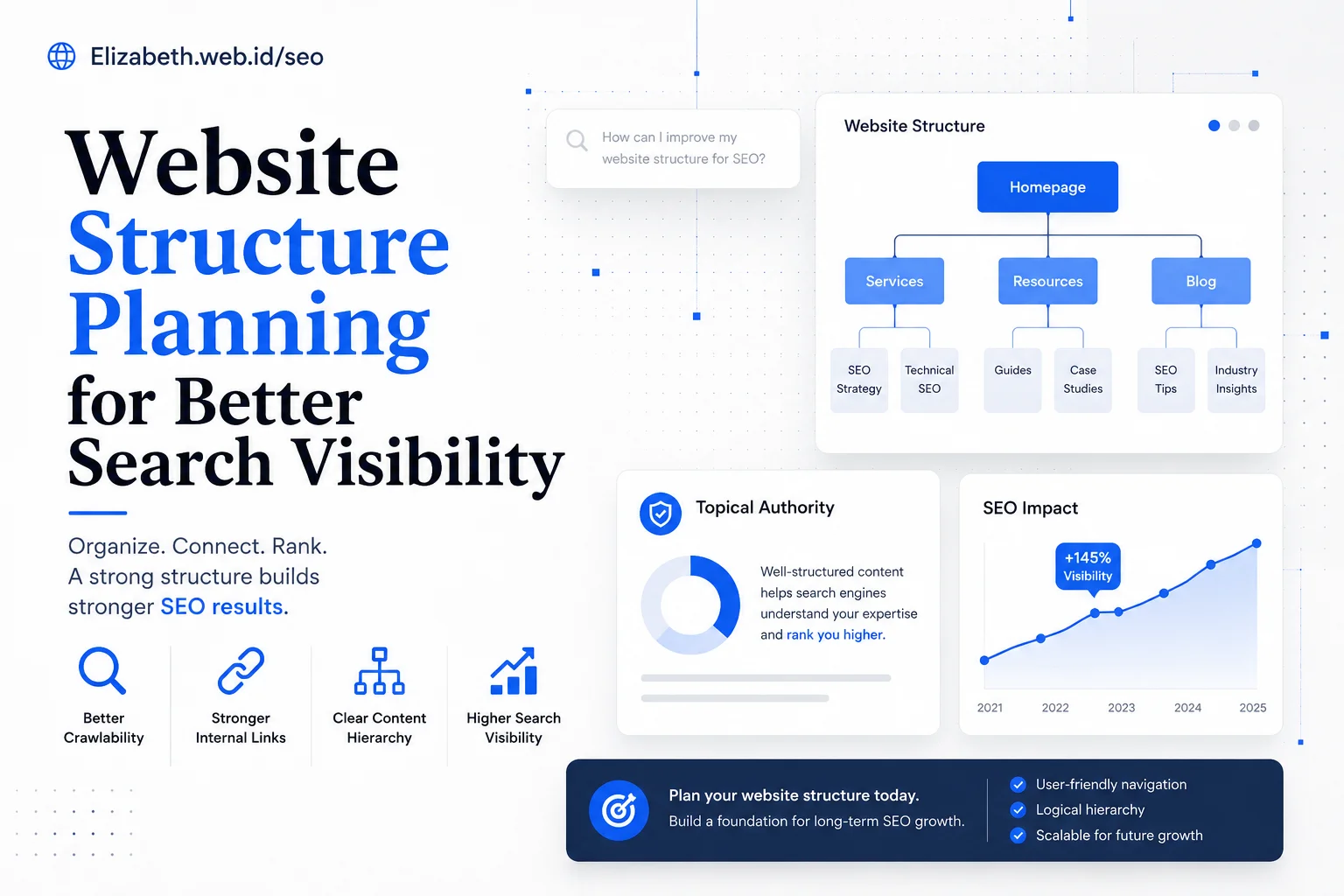
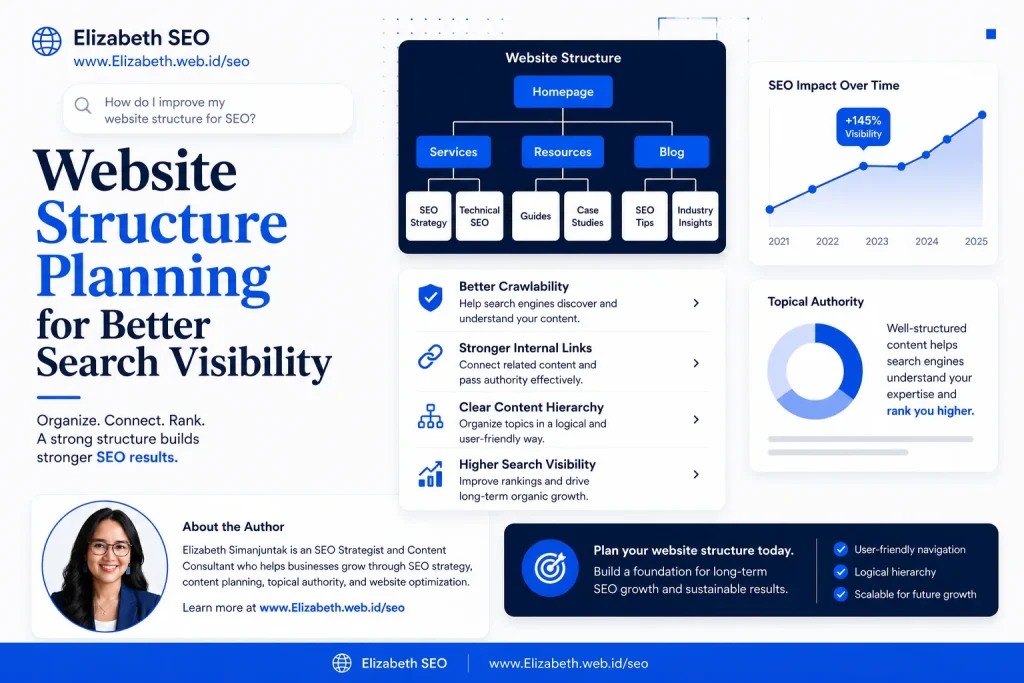
A well-planned website structure helps both users and search engines understand your content more effectively. By organizing pages, categories, navigation, and internal links strategically, businesses can improve crawlability, strengthen topical authority, and support long-term SEO growth.
Many businesses invest heavily in content creation but overlook the foundation that determines whether that content can be discovered and understood. Without a clear structure, even high-quality content can struggle to achieve sustainable search visibility.
Website structure planning is the process of organizing pages, categories, navigation, and internal links so users and search engines can understand content more easily. A well-structured website improves crawlability, supports topical authority, strengthens internal linking, and creates a scalable foundation for long-term SEO growth.
What Is Website Structure Planning?
Website structure planning is the process of organizing a website’s pages, categories, navigation menus, and content hierarchy to create a logical user experience and improve search engine understanding.
Think of your website as a digital library. If books are placed randomly on shelves, visitors will struggle to find what they need. The same principle applies to websites. When content is grouped logically, users navigate more easily and search engines can better understand how topics relate to each other.
A typical website structure includes:
- Homepage
- Service Pages
- Category Pages
- Blog Content
- Resource Pages
- Contact Page
Each page should have a clear purpose and a defined place within the overall hierarchy.
Why Is Website Structure Important for SEO?
Website structure plays a critical role in how search engines discover, crawl, and evaluate content.
A well-structured website helps improve:
Crawlability
Search engines use links to discover pages.
When pages are organized logically and connected through internal links, search engines can find and index content more efficiently.
Poor website structures often leave important pages buried deep within the site architecture, making them harder to discover.
Topical Authority
Modern SEO increasingly rewards websites that demonstrate expertise around specific topics.
When related content is grouped into categories and topic clusters, search engines gain stronger signals about your expertise and subject relevance.
For example:
SEO Strategy
- Keyword Research
- SEO Roadmaps
- Content Planning
Technical SEO
- Site Audits
- Core Web Vitals
- Crawl Optimization
This structure creates stronger topic associations than publishing unrelated articles without organization.
User Experience
Website structure is not only for search engines.
Visitors should be able to navigate naturally and locate information quickly.
Clear navigation often contributes to:
- Higher engagement
- Longer session duration
- Lower bounce rates
- Better conversion opportunities
Long-Term Scalability
As businesses grow, so does their content.
A structured website allows new pages and articles to fit naturally into existing categories without creating confusion or content overlap.
Why Website Structure Matters More in AI Search
Search behavior is changing.
Today, users may discover your content through Google Search, Google AI Overviews, ChatGPT Search, Perplexity, Gemini, and other AI-powered search experiences.
Google’s documentation explains that crawlable links and logical site structures help search engines discover and understand content more effectively. Internal linking also helps search engines identify relationships between pages and determine which content is most important.
As AI search systems become more sophisticated, content organization plays an even larger role. Well-structured content with clear headings, direct answers, topic clusters, and logical hierarchies is often easier for AI systems to interpret, summarize, and cite.
In other words, website structure is no longer just an SEO consideration—it is becoming an AI visibility consideration as well.
What Are the Benefits of a Well-Structured Website?
Businesses that invest in website structure planning often experience several long-term advantages.
Improved Search Visibility
Clear hierarchies help search engines understand which pages are most important.
Better Internal Linking Opportunities
Related content can be connected naturally, strengthening relevance signals throughout the website.
Stronger Content Organization
Users can discover related information more easily, increasing engagement and trust.
Easier Website Maintenance
Teams can expand content without creating duplicate categories, overlapping topics, or navigation issues.
Common Website Structure Mistakes Businesses Make
In many SEO audits, one of the most common problems is not a lack of content—it is a lack of organization.
Businesses often publish articles for months or years without first defining categories, content hubs, or internal linking strategies.
As content grows, rankings become more difficult to improve because search engines struggle to understand how pages relate to one another.
Common mistakes include:
Publishing Content Without Categories
Articles are published randomly without clear topic organization.
As a result, search engines struggle to identify topical relationships.
Creating Too Many Menu Items
Large navigation menus often create confusion and dilute the visibility of important pages.
Duplicate Topic Pages
Multiple pages targeting similar topics can create keyword cannibalization and weaken authority signals.
Deep Website Architecture
If users need five or six clicks to reach important pages, both user experience and crawl efficiency can suffer.
Important pages should ideally remain accessible within a few clicks from the homepage.
Experience from Real SEO Projects
Over the years, I have reviewed websites ranging from local businesses to service-based companies that struggled to gain organic visibility despite publishing content consistently.
One recurring issue is the lack of a clear website structure.
In many cases, businesses create dozens of articles before defining content categories, topic clusters, or internal linking paths. As a result, valuable content becomes isolated, important service pages receive little internal authority, and search engines struggle to understand the overall topic landscape.
After restructuring content hierarchies, consolidating overlapping topics, and improving internal linking, websites often become easier to crawl, easier to manage, and better positioned for future SEO growth.
Website structure planning may not be the most visible part of SEO, but it is often one of the most impactful.
How Do You Create an SEO-Friendly Website Structure?
A successful website structure begins with strategic planning rather than content production.
Step 1: Define Core Topics
Identify the primary topics your business wants to be known for.
For example, an SEO consultant may focus on:
- SEO Strategy
- Technical SEO
- Content SEO
- Local SEO
These topics become the foundation of future content clusters.
Step 2: Build Topic Clusters
Each core topic should have supporting content.
Example:
Content SEO
- Content Optimization Guide
- Search Intent Analysis
- Content Audits
- On-Page SEO Best Practices
Topic clusters help strengthen authority around a specific subject area.
Step 3: Create Category Pages
Category pages act as content hubs.
They help both users and search engines understand how related content connects.
Examples:
- /seo-strategy/
- /technical-seo/
- /content-seo/
- /local-seo/
Step 4: Design Internal Linking Paths
Internal linking helps distribute authority throughout your website.
For example, an article about keyword research can link to:
- SEO Strategy Service Page
- Content Planning Guide
- Topic Cluster Framework
These connections help search engines understand content relationships.
Step 5: Keep Important Pages Close to the Homepage
Pages that generate leads, inquiries, or revenue should receive strong internal linking support and remain easily accessible.
The fewer clicks required to reach important pages, the better.
Example of an SEO-Friendly Website Structure
A service-based business might organize its website like this:
Homepage
→ Services
→ SEO Strategy
→ Technical SEO
→ Content SEO
→ Local SEO
→ Resources
→ SEO Guides
→ Case Studies
→ Blog
→ Contact
This hierarchy provides a clear path for both users and search engines.
Which SEO Concepts Support Website Structure Planning?
Several SEO concepts work closely with website architecture.
These include:
- Internal Linking
- Topic Clusters
- Crawlability
- Search Intent
- Information Architecture
- Topical Authority
- User Experience (UX)
SEO professionals commonly use tools such as Google Search Console, Ahrefs, Semrush, and Screaming Frog to evaluate website structure and identify optimization opportunities.
Related Resources
To build a stronger SEO foundation, consider exploring these related topics:
- Keyword Research and Content Opportunity Analysis
- Content Strategy Planning for Sustainable SEO Growth
- Internal Linking Strategies That Support Topical Authority
- On-Page SEO Optimization for Service-Based Businesses
- SEO Content Planning for Long-Term Organic Traffic
- Website Audit Checklist for Small Businesses
Together, these topics help create a complete SEO framework rather than focusing on isolated tactics.

Frequently Asked Questions About Website Structure Planning
What is website structure planning?
Website structure planning is the process of organizing pages, categories, navigation, and content hierarchies to improve user experience and search engine understanding.
Why is website structure important for SEO?
A well-structured website improves crawlability, strengthens topical authority, supports internal linking, and helps search engines understand relationships between pages.
How many clicks should a page be from the homepage?
Although there is no official rule, many SEO professionals recommend keeping important pages within three clicks of the homepage whenever possible.
Does website structure affect search visibility?
Yes. Website structure helps search engines discover, crawl, and understand content more effectively, which can positively influence search visibility.
What is the difference between website structure and internal linking?
Website structure refers to the overall organization of pages and categories, while internal linking refers to the connections between individual pages.
Both work together to improve SEO performance.
Should small businesses care about website structure?
Absolutely. Even small websites benefit from clear organization because it improves user experience and creates a stronger foundation for future content growth.
What Business Owners Should Know
- Website structure planning helps users and search engines navigate content more effectively.
- A clear hierarchy improves crawlability and content discovery.
- Topic clusters strengthen topical authority and relevance.
- Internal linking supports page relationships and SEO performance.
- Well-organized websites are easier to scale as content grows.
- Website structure plays an important role in both traditional SEO and AI-powered search visibility.
- Planning architecture early helps prevent SEO challenges later.
What This Means for Your Business
Website structure planning is one of the most overlooked aspects of SEO, yet it often determines how effectively search engines understand a website.
Before creating more content, businesses should ensure their pages, categories, navigation, and internal linking systems support their long-term goals.
A strategic website structure creates a stronger foundation for search visibility, improves user experience, strengthens topical authority, and makes future SEO efforts significantly more effective.
The best time to plan your website structure is before you publish hundreds of pages. The second-best time is today.