Many businesses create content consistently but still struggle to generate meaningful organic traffic, qualified leads, or business results.
The problem is often not content quality.
The problem is targeting the wrong keywords.
Not every keyword is worth pursuing. Some keywords attract visitors who are unlikely to become customers, while others are too competitive, too broad, or disconnected from business goals.
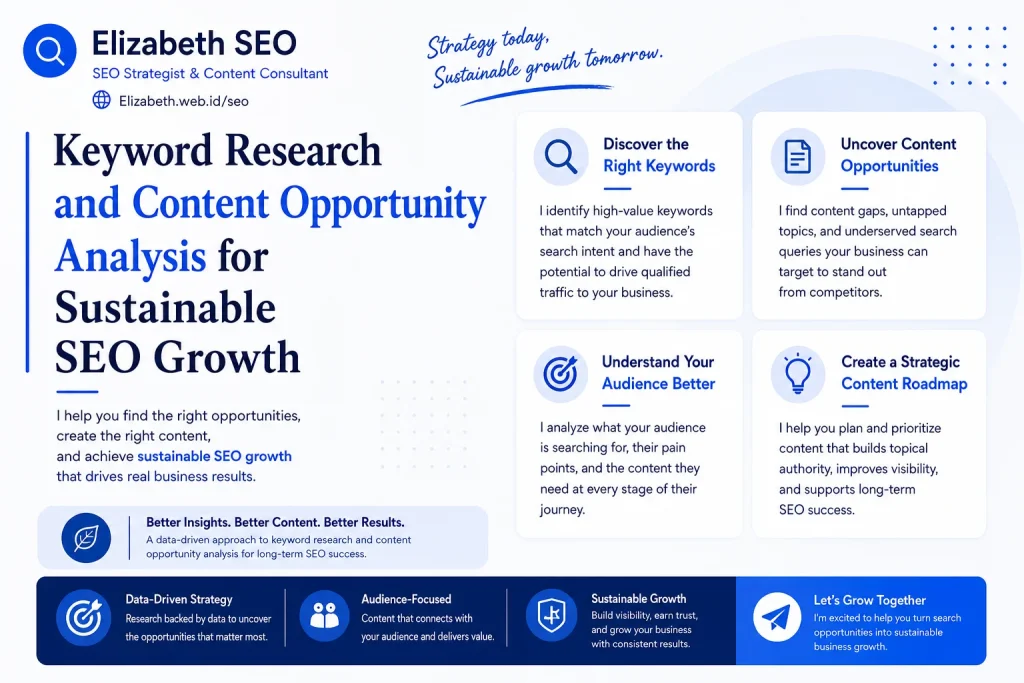
Keyword Research and Content Opportunity Analysis help businesses identify search opportunities that align with audience needs, customer intent, and long-term business growth.
Keyword research and content opportunity analysis is the process of identifying search terms, questions, content gaps, and topic opportunities that can attract qualified visitors and support business goals. Rather than chasing search volume alone, effective keyword research focuses on relevance, search intent, competition, customer journey stages, and conversion potential.
What Is Keyword Research and Content Opportunity Analysis?
Keyword research is the process of discovering the words, phrases, and questions people use when searching online.
Content opportunity analysis goes further by identifying topics and content gaps where a business can realistically compete, build authority, and attract qualified visitors.
Together, they help answer critical questions:
- What information is my audience searching for?
- Which topics align with my products or services?
- Where are competitors gaining visibility?
- Which keywords have commercial value?
- What content should be prioritized first?
Without these insights, content creation often becomes guesswork.
Why Is Keyword Research Important for SEO?
Search engines connect users with relevant content.
If your website is not targeting the topics and questions your audience searches for, visibility becomes difficult regardless of how well-written your content may be.
Effective keyword research helps improve:
Search Visibility
Targeting relevant keywords increases the likelihood of appearing in search results when potential customers actively seek solutions.
Content Relevance
Keyword research reveals the language, questions, concerns, and interests of your audience.
Content Prioritization
Businesses can focus on topics with the highest strategic value instead of publishing content randomly.
Lead Generation
The right keywords attract visitors who are closer to making purchasing decisions.
Why Content Opportunity Analysis Matters More Than Search Volume
One of the biggest misconceptions in SEO is that higher search volume automatically means better results.
In reality, lower-volume keywords often generate stronger business outcomes.
For example:
Keyword A
- 15,000 monthly searches
- Informational intent
- Broad audience
- Low conversion potential
Keyword B
- 300 monthly searches
- Commercial intent
- Decision-stage audience
- High conversion potential
Many businesses generate more leads from Keyword B than Keyword A.
The goal of SEO is not simply to attract traffic.
The goal is to attract the right audience.
Why Search Intent Matters More Than Ever
Google increasingly prioritizes content that satisfies search intent.
Search intent generally falls into four categories:
Informational
Users want to learn something.
Example:
- What is keyword research?
Navigational
Users are looking for a specific website or brand.
Example:
- Ahrefs keyword explorer
Commercial Investigation
Users are comparing options before making a decision.
Example:
- Best SEO tools for small businesses
Transactional
Users are ready to take action.
Example:
- Hire an SEO consultant
Understanding intent helps businesses create content that matches what users actually want.
The 5-Step Keyword Opportunity Framework
When evaluating keyword opportunities, I use a framework that focuses on both visibility and business value.
Step 1: Business Alignment
Ask:
Does this keyword align with products, services, expertise, or business goals?
A keyword may generate traffic but still have little business value.
Step 2: Audience Research
Identify:
- Common questions
- Pain points
- Frustrations
- Goals
Strong keyword opportunities often emerge from real audience problems.
Step 3: Intent Analysis
Understand why users search for a keyword.
Intent often determines:
- Content format
- Content depth
- Conversion opportunities
Step 4: Opportunity Scoring
Evaluate:
- Competition level
- Authority requirements
- Ranking potential
- Search demand
Not every keyword offers a realistic opportunity.
Step 5: Content Prioritization
Focus first on opportunities that combine:
- Strong relevance
- Achievable competition
- High business value
Keyword Opportunity Checklist
Before targeting a keyword, ask:
✓ Does it align with business goals?
✓ Does it match user intent?
✓ Can it attract qualified visitors?
✓ Is there realistic ranking potential?
✓ Does it support the customer journey?
✓ Can it generate leads, inquiries, or revenue?
✓ Does it strengthen topical authority?
If the answer is “yes” to most of these questions, the keyword may be worth pursuing.
Common Keyword Research Mistakes Businesses Make
Many websites struggle because keyword research is approached incorrectly.
Chasing High-Volume Keywords
Large search volume often attracts greater competition and may not align with business objectives.
Ignoring Search Intent
Ranking means little if visitors are not looking for what your business offers.
Copying Competitors
Competitor research is valuable, but simply duplicating competitor content rarely creates a sustainable advantage.
Focusing Only on Keywords
Modern SEO involves more than keywords.
Search engines increasingly evaluate:
- Topics
- Entities
- Relationships
- Expertise
- User satisfaction
Experience from Real SEO Projects
During SEO audits for service businesses, SaaS companies, and local brands, I frequently find websites targeting broad keywords with impressive search volume but little commercial value.
In many cases, businesses spend months creating content that attracts visitors who are unlikely to become customers.
After conducting keyword research and content opportunity analysis, the content strategy often changes significantly.
Instead of targeting broad informational keywords, the focus shifts toward decision-stage topics, commercial-intent searches, and content that aligns with customer needs.
In several projects, a smaller number of strategically targeted pages generated stronger business results than publishing dozens of unfocused articles.
Keyword research is not about finding more keywords.
It is about finding better opportunities.
How Keyword Research Supports AI Search Visibility
Search behavior is evolving.
Today, people search through Google, ChatGPT Search, Perplexity, Gemini, Claude, and other AI-powered platforms.
These systems increasingly surface content that demonstrates expertise, topical relevance, and clear answers.
Effective keyword research helps businesses identify:
- Questions users ask AI systems
- Decision-stage queries
- Topic relationships
- Content gaps
- Authority-building opportunities
Rather than focusing solely on rankings, modern keyword research helps businesses become discoverable across both traditional search engines and AI-powered answer engines.
This is one reason why understanding search intent and topic relationships has become increasingly important.
Which SEO Concepts Support Keyword Research?
Keyword research works alongside several important SEO concepts.
These include:
- Search Intent
- Topic Clusters
- Topical Authority
- Internal Linking
- Customer Journey Mapping
- Information Architecture
- Content Strategy
SEO professionals often use tools such as Google Search Console, Google Trends, Ahrefs, and Semrush to identify opportunities and measure performance.
Why Businesses Work With Elizabeth
Keyword research is not simply about identifying keywords with search volume.
I help businesses identify opportunities that align with customer intent, business goals, and long-term growth potential.
The result is a content strategy focused on visibility, relevance, authority, and meaningful business outcomes rather than vanity metrics.
Whether the goal is generating leads, increasing qualified traffic, building topical authority, or improving AI search visibility, the focus remains the same:
Finding opportunities that matter.

Related Resources
To build a stronger SEO foundation, explore these related topics:
- Website Structure Planning for Better Search Visibility
- Content Strategy Planning for Sustainable SEO Growth
- Internal Linking Strategies That Support Topical Authority
- On-Page SEO Optimization for Service-Based Businesses
- SEO Content Planning for Long-Term Organic Traffic
Together, these elements create a more effective and sustainable SEO strategy.
Frequently Asked Questions About Keyword Research
What is keyword research?
Keyword research is the process of identifying search terms people use when looking for information, products, or services online.
Why is keyword research important?
Keyword research helps businesses understand audience demand, create relevant content, and improve search visibility.
Should I target high-volume keywords?
Not always. Relevance, search intent, and business value are often more important than search volume.
What is content opportunity analysis?
Content opportunity analysis identifies gaps, opportunities, and topics where a business can create valuable content that supports SEO and business objectives.
Can AI tools replace keyword research?
AI tools can assist with research, but strategic keyword selection still requires understanding business goals, customer intent, competition, and conversion potential.
How does keyword research help AI Overview visibility?
Keyword research helps identify questions, topics, and content structures that AI systems can easily understand, summarize, and surface in search experiences.
What keywords are most valuable for service businesses?
Keywords that align with customer intent, decision-making stages, and business objectives often provide the highest value.
Main Points
- Not every keyword is worth targeting.
- Search intent matters more than search volume.
- Content opportunity analysis helps identify realistic growth opportunities.
- Strong keyword research supports both SEO and AI search visibility.
- Topic relevance and business alignment should guide content decisions.
- Strategic keyword targeting often produces better results than publishing more content.
- Effective SEO focuses on attracting qualified visitors, not just traffic.
Looking Beyond Keywords
Successful SEO is not about targeting the most keywords.
It is about understanding your audience, identifying meaningful opportunities, and creating content that supports both user needs and business goals.
When keyword research is approached strategically, it becomes more than an SEO task.
It becomes a roadmap for sustainable search visibility, better content decisions, stronger authority, and long-term business growth.